Have you seen other crafters turn out seamless sublimation tumblers but you can't seem to get the hang of it? If you've been searching for "How do you sublimate a tumbler at home?" or "What temperature do you sublimate tumblers?" — this guide has you covered. Personalizing drinkware is an easy, fun way to make unique gifts or build a customization business. This article walks through everything you need: the supplies, the step-by-step process for both heat press and oven methods, and tips for achieving seamless full-wrap designs.
The Supplies You Need
Gathering the right sublimation supplies before you begin will save you time and help you avoid common beginner mistakes.
A sublimation-ready tumbler has a polymer coating that bonds with sublimation ink. Without this coating, the process won't work — the ink has nothing to grip. Most crafters prefer stainless steel or aluminum tumblers for their durability.
Smaller tumblers — 12 and 20 oz — limit the design area but have great visual impact. Larger tumblers — 30 or 40 oz — offer more space for detailed designs. If you're selling tumblers, the 20 oz size is the most popular and fits most cup holders.
Beginner-Friendly Guide to Sublimate a Tumbler
Follow these steps to create, print, and transfer your design — using either a heat press or convection oven.
Create the Design
Use Adobe Illustrator, Photoshop, or Canva to create or edit your design. Canva is a favorite for beginners thanks to its simple interface and beautiful templates. Start with a blank canvas, set the dimensions to match your tumbler, and design with colors, text, and graphics. Upload your own images for extra personalization.
Remember: All sublimation designs must be mirrored before printing. Canva doesn't have a built-in flip function — download the design, re-upload it, and use the rotate function to mirror it manually, or use an external editor.
For best quality, download in PNG format at 300 DPI. Larger fonts work better for sublimation — they're easier to read on curved surfaces.
Print the Design
Set up your printer with compatible sublimation ink and sublimation paper loaded in the tray. Mirror the design if you haven't already — printing in reverse ensures the final transfer reads correctly. Adjust print settings for sublimation paper type and print quality, then trim away white edges after printing.
Get the Tumbler Ready
For a flawless transfer, the tumbler must be clean and dry. Wash it with warm water to remove oils and dirt, then dry completely with a lint-free cloth. Measure the tumbler's circumference to ensure your design fits properly.
Wrap the design around the tumbler and secure it with heat-resistant tape. Push out any air bubbles using a squeegee.
Sublimate the Design
Convection Oven Method
Preheat the oven to 375°F (190°C). Conventional ovens have slight temperature variations, so use an oven thermometer to monitor consistency. Silicon bands or heat-resistant tape help distribute heat evenly and keep the paper in place.
Place the tumbler on an oven rack — lined with aluminum foil for extra protection. Set the timer for 6–10 minutes depending on tumbler size. About halfway through, rotate the tumbler 180 degrees for even transfer. If the design hasn't fully transferred after the timer, leave it in for an additional 2 minutes. Use heat-resistant gloves to remove the tumbler, let it cool for a few minutes, then peel away the tape and paper.
Heat Press Method
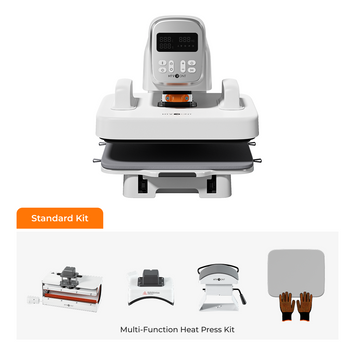
A dedicated tumbler heat press is easier to use than a general flat heat press. Set the temperature to 375–400°F (190–204°C) depending on tumbler thickness, with a pressing time of 50–60 seconds at medium pressure. Always check the manufacturer's specifications.
Tip: If your tumbler has a handle, place it facing away from the heating element. High heat can weaken or discolor the handle. Use medium pressure for handled tumblers.
Place a Teflon sheet around the sublimation paper to protect the press from ink residue. After pressing, remove the hot tumbler with heat-resistant gloves, cool for a few minutes, and peel away the tape and paper to reveal your design.
Additional Touches
After the tumbler has fully cooled, check for any residue from the heat-resistant tape. Wipe it away with rubbing alcohol and a soft cloth. For added protection, apply a thin layer of food-safe, heat-resistant sealant around the tumbler. Finish with a final clean using a microfiber cloth to remove fingerprints.
✓ Tumbler Sublimation Quick Checklist
□ Use a sublimation-ready tumbler with polymer coating
□ Create design at 300 DPI and mirror before printing
□ Print with compatible sublimation ink and paper
□ Clean tumbler thoroughly with warm water and lint-free cloth
□ Wrap design tightly and secure with heat-resistant tape
□ Push out air bubbles with squeegee
□ Heat press: 375–400°F for 50–60 seconds
□ Oven: 375°F for 6–10 minutes, rotate halfway
□ Cool completely before peeling paper
□ Apply sealant for extra durability
How to Sublimate a Design with No Seams
Seamless full-wrap designs look professional and polished — the key is precise measurements, tight wrapping, and even heat distribution.
Seamless designs wrap completely around the tumbler with no visible start or end point. The challenge lies in perfectly aligning the paper edges and ensuring the design covers the entire circumference. Here's how to nail it every time.
Measure the Tumbler
Measure the tumbler's height and circumference, then add 2mm to both for slight overlap. These measurements should exactly match your design's dimensions.
Trim the Print
Use scissors to trim away white edges and excess paper for a tight fit around the tumbler.
Wrap the Design Around the Tumbler
Wrap the sublimation sheet around the tumbler with edges meeting precisely. Seal the seam with heat-resistant tape.
Use a Scraper to Remove Bubbles
Press along the seam with a flat-edged scraper or squeegee to remove trapped air. Smooth the paper evenly to eliminate wrinkles. Optionally, cover with a shrink wrap sleeve and shrink with a heat gun for even pressure.
Transfer the Design
Use a heat press or convection oven as described above. Cool the tumbler and apply a protective sealant if desired.
Frequently Asked Questions
Quick answers to the most common questions about sublimating tumblers.
What temperature do you sublimate a tumbler?
For a tumbler heat press, use 375–400°F (190–204°C) for 50–60 seconds. For a convection oven, set the temperature to 375°F (190°C) and bake for 6–10 minutes depending on tumbler size. Always check the manufacturer's specifications for your specific blank.
Why won't my sublimation stick to the tumbler?
The most common reason is using a tumbler without a polymer coating. Sublimation ink only bonds with polyester or polymer-coated surfaces. Check that your tumbler is "sublimation-ready" and ensure the surface is clean and free of oils before applying the design.
Do I need to mirror my design for tumbler sublimation?
Yes! Always mirror your design before printing. Since the printed design is placed face-down on the tumbler during transfer, an unmirrored design will appear backwards in the final result.
Can I use a regular oven for sublimation?
A convection oven works better than a conventional oven because it circulates heat more evenly around the tumbler. If using a conventional oven, rotate the tumbler halfway through the baking time to ensure even transfer. Never use an oven that's also used for food preparation.
What is the best tumbler size for sublimation?
20 oz tumblers are the most popular choice — they fit most cup holders and offer a good balance of design space and visual impact. If you're selling tumblers, 20 oz is the safest bet. For detailed designs, 30 or 40 oz tumblers provide more surface area.
How do I prevent seams and lines in my tumbler design?
Measure the tumbler's circumference precisely and add 2mm for overlap. Trim the paper tightly, wrap it with edges meeting perfectly, and use a squeegee to remove air bubbles. Shrink wrap sleeves help apply even pressure for seamless results.
Sublimating tumblers is one of the most rewarding DIY projects — once you nail the basics, the creative possibilities are endless. Whether you use a heat press or a convection oven, the keys are a quality sublimation-ready tumbler, a properly mirrored design, and precise temperature control. With practice, you'll turn out professional-looking drinkware that makes great gifts or a profitable product line.
Want to master the full sublimation workflow? Our sublimation temperature guide covers the exact heat, pressure, and time settings for every substrate — including tumblers, mugs, shirts, and more.


 Cart Unlocks Add-On Deals