Introduction
Staring at a design with photo‑style gradients, hair‑thin lines, and tiny text, you've probably had the same thought: can screen printing really reproduce something this detailed on a shirt—cleanly and consistently? And if it can, will it stay consistent across a whole batch? And if it won't, is all that setup time actually worth it? Let's walk through the science, the real‑world constraints, and the most practical paths forward so you can get the result you want with fewer expensive surprises.
Let's start with the direct answer—and the three questions that matter more than "can it be done."
The Straight Answer: Yes, Screen Printing Can Do Gradients—But It's Not Always the Smartest Choice
"Can screen printing handle gradient and complex designs on clothing?" Yes. But the decision usually turns on three very practical questions: Is the cost predictable and reasonable for your order size? Can you keep print‑to‑print consistency? And is the failure and rework risk acceptable?
Screen printing is like a sledgehammer in the best way: bold solids, strong opacity, durable ink laydown, great for volume. Gradients and photo‑like artwork are more like fine engraving: subtle tone transitions, delicate details, and extremely tight tolerance. A sledgehammer can do fine work—but only if you change the entire approach and control the process like a hawk.
To understand why gradients are challenging, we first need to appreciate what screen printing does naturally best.
Why Screen Printing Is Naturally Great at Solid Colors—And How It Can "Fake" Gradients Convincingly
At its core, screen printing pushes ink through a mesh stencil onto fabric. That physical transfer creates a thicker ink deposit than many other decoration methods, which is why it's so loved for bold graphics, strong coverage, and longevity.
So how do gradients happen? The most common reliable method is halftones—converting continuous tones into a field of dots that your eyes blend into smooth shading. That's exactly what halftone reproduction is designed for: using dot size and dot spacing to simulate continuous tone. Bigger and denser dots read darker; smaller and sparser dots read lighter. From normal viewing distance, your brain does the mixing, and the gradient "appears." If this reminds you of newspaper photos, you're not imagining it. Halftones are a classic print solution for continuous‑tone images—just being applied to a very different surface: fabric rather than paper. And that difference matters.

With the fundamentals covered, let's examine the four main techniques—and what each one demands from you.
Four Common Ways Screen Printing Tackles Gradients and Complex Artwork (And What Each One Costs You)
Screen printing can absolutely pull off complex art—but different methods trade off cost, difficulty, and consistency. Halftones are the workhorse but depend on tight process control; CMYK offers photo‑like color but registration becomes critical; spot colors give brand accuracy at the cost of more screens; and wet‑on‑wet blending creates beautiful art but sacrifices repeatability.
1. Halftones: The Most Common Method—And the Most Dependent on Fundamentals
Halftone dots are the workhorse of gradients in screen printing. But the finer the dot pattern, the more fragile the system becomes. You want a buttery‑smooth fade; the process might hand you dot gain, plugged screens, or lost highlights. You want crisp facial detail; you might get "muddy shadows." Why so touchy? Because halftones demand tight control of mesh count, exposure, ink rheology, squeegee pressure, off‑contact, and garment stability. One variable drifts and the dots don't behave.
2. CMYK Process Printing: Closer to Photos, but Registration Becomes the Boss
If you want photo‑like color range, many shops use CMYK process separations—Cyan, Magenta, Yellow, and Black—each screened as halftone dots and overprinted to visually mix colors. That approach sits within the broader logic of color printing, where layered inks and halftone structures create the perception of full color. It's elegant. It's also unforgiving. A tiny registration shift can produce color halos and "double edges." A slight change in pressure can muddy skin tones. A fabric batch with different absorbency can change how dots spread. Industry guidance regularly points out that printing halftone process color on textiles is fundamentally different—and often harder—than printing on paper, because fabric texture and ink behavior change the game.
3. Spot‑Color Multi‑Screen Printing: Better Color Control, but Screens Add Up Fast
If exact brand color is the priority, spot colors can be more controllable than CMYK. But gradients and complex illustrations typically require more separations and more screens. More screens means more setup time, more chances to misregister, more opportunities for rework, and higher per‑job overhead—especially painful for small runs. It can look fantastic, but it's not the "easy button."
4. On‑Press Ink Blending / Wet‑on‑Wet: Gorgeous, Artsy, and Consistency Becomes a Weather Forecast
Blending multiple inks on the same screen—or using wet‑on‑wet techniques—can create striking fades and poster‑style vibes. But if you need every piece to match perfectly, this method is a gamble. It's more "handmade character" than "industrial repeatability." Are you okay with each shirt having its own personality? Or are you trying to deliver identical units? That one question can save you a lot of frustration.
So screen printing can do it. But should it? Here are the real‑world limits that often push creators toward other solutions.
Why "Possible" Doesn't Always Mean "Practical": The Real Limits You Have to Respect
Even when gradients are technically achievable, four constraints often decide whether screen printing is the best path: small runs get punished by setup economics, complexity ramps up non‑linearly, dark shirts require a white underbase adding more variables, and artistic gradient methods inherently fight standardized production demands.
1. Small Runs Get Punished by Setup Economics
Screen printing costs often live in the front end: films, screens, exposure, setup, test prints, dialing in registration. Large volume spreads that cost. Small volume makes it sting. If you're only producing 10–20 gradient tees, the prep can easily outweigh the actual printing time.
2. Complexity Doesn't Increase Difficulty Linearly—It Ramps Up Fast
One‑color printing is a flat road. Multi‑color printing is a hill. CMYK halftone on textiles can feel like rock climbing. Tiny type, thin lines, and faces are where errors show first. You want the print to look "premium," and the process is most likely to fail exactly at the premium details.
3. Dark Shirts Often Require a White Underbase (More Steps, More Variables)
To keep gradients bright on dark garments, you commonly need a white underbase. That can mean extra screens, flash curing, added passes, and more chances for variation. Doable—just not "simple."
4. Standardized Production and Artistic Gradients Often Fight Each Other
You want batch‑to‑batch consistency and predictable delivery. Some gradient methods inherently produce variation. One demands uniformity; the other naturally creates small differences. Which matters more for your customers and your brand?
📖 Looking for a decoration method that handles gradients and complex art more consistently?
-
What Is DTF Printing? – A beginner‑friendly overview of how Direct‑to‑Film handles photo‑quality designs on nearly any fabric.
With the limitations clear, let's look at three practical paths—including when DTF is the smarter choice.
Practical Solutions: Don't Just Ask "Can Screen Printing Do It?"—Ask "What Gets My Result Most Reliably?"
The smarter move is choosing a route that matches your order size, design complexity, and production reality. Three paths cover the most common scenarios: high‑volume screen printing for lowest unit cost, DTF for small batches and complex art, and a hybrid workflow that lets each method do what it does best.
Route A: High Volume, Fixed Design, Lowest Unit Cost
If you're making hundreds or thousands of pieces with the same artwork, screen printing is still a powerhouse. With a stable shop and proven process—spot colors or mature halftone and CMYK workflows—you can drive unit cost down and durability up. The key is experience—because in screen printing, experience isn't a nice‑to‑have; it's part of the budget.
Route B: Small Batches, Frequent Design Changes, Photo Gradients, Extreme Detail
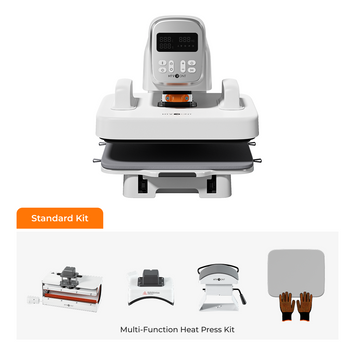
This is where DTF often shines: use a DTF Printer to print the design onto film, apply powder, cure it, and then transfer it onto the garment using a Heat Press or T‑shirt press. The core advantage is simple: you "lock" the complexity into the printing step instead of spreading complexity across multiple screens and live press adjustments. Need to swap designs constantly? Add names? Run many small custom jobs? DTF usually handles that flexibility with far less overhead than remaking screens. And for gradients and photo‑like artwork, DTF output can be more consistent because you're not battling multi‑screen registration shifts that create halos and double images. Once you dial in film, powder, curing, press temperature, time, pressure, and peel method, repeatability is typically strong.
Route C: Hybrid Workflow: Let Each Process Do What It's Best At
Want the classic screen print feel—bold, matte, substantial—and photo‑grade gradient detail? Combine methods: use screen printing for large solid areas, text, and logos; use DTF for the complex gradient and photo portions; apply the transfers consistently with a Heat Press. It's like cooking: sear on high heat, then reduce on low. Different tools for different steps—better overall results.
🖨️ Ready to explore the DTF workflow?
A Three‑Minute Decision Checklist: What Should You Choose?
Screen printing is more likely the right choice if you have high volume where setup costs can be spread out, a fixed design you'll reprint long‑term, manageable color count or proven halftone and CMYK experience, and top priorities like wash durability, coverage, and throughput.
DTF Printer + Heat Press / T‑shirt press is more likely the right choice if you have small runs with many designs and frequent changes, gradients, photos, complex illustration, or ultra‑fine lines, priorities like fast sampling and consistent reproduction, and limited desire to spend time on screens, separations, and registration tuning.
It's not about which method is "more advanced." It's about which method fits your production reality.
Frequently Asked Questions
Can screen printing produce photo‑quality results on T‑shirts?
Yes—through CMYK process printing with halftone separations. But it requires a highly experienced printer, tight registration control, and consistent fabric. Results can be excellent, but the margin for error is much smaller than with solid spot‑color work. Many shops that specialize in this have spent years dialing in their process.
What's the minimum order quantity that makes screen printing gradients worthwhile?
There's no universal number, but most shops consider 24–36 pieces the practical minimum for multi‑color work to justify setup costs. For CMYK process printing with gradients, 50+ pieces is a more realistic threshold. Below that, DTF transfers typically offer better economics and more predictable results.
Why do gradients on dark shirts cost more to screen print?
Dark shirts almost always require a white underbase to make colors pop. This adds at least one extra screen, an additional print pass, and often a flash cure between layers. More steps mean more setup time, more chances for misregistration, and higher per‑piece costs—especially noticeable on small runs.
Is DTF a complete replacement for screen printing gradients?
Not completely. DTF excels at complex, photo‑quality designs on small to medium runs. But screen printing still wins on large volume economics, offers a unique matte finish and softer hand that some brands prefer, and can produce a different aesthetic that DTF doesn't replicate. Many professional shops use both methods, choosing based on the specific job requirements.
Final Thought: You Don't Really Want "Possible"—You Want "Repeatable"
So, can screen printing produce gradient and complex designs on clothing? Yes! The foundation is well‑established: halftone techniques can simulate continuous tone, and process color printing explains how layered ink structures can visually create full‑color images. But turning that theory into reliable, repeatable production on textiles is where the challenge lives—and industry technical guidance is very clear that apparel printing behaves differently than paper printing. So here's the real question: are you ready to invest in volume, expertise, and setup time to earn that classic screen print feel and durability? Or would you rather print the complexity cleanly with a DTF Printer and apply it reliably with a Heat Press or T‑shirt press, so even small runs can look consistent and professional? Pick the right route, and gradients stop being a nightmare, complex artwork stops being a dealbreaker, and your idea‑to‑shirt path gets dramatically smoother.


 Cart Unlocks Add-On Deals