Introduction
When people ask whether a phone case heat press machine can press DTF (Direct to Film) prints, what they're really asking is: "Can I use one machine to do everything?" The practical answer is not recommended. Yes, a phone case heat press can generate heat and pressure, but it's built around a very specific workflow—vacuum forming for full‑wrap sublimation—and that workflow doesn't match how DTF materials behave. To make the decision easy and prevent expensive trial‑and‑error, this article explains the difference between DTF and sublimation, why a phone case heat press relies on sublimation film vinyl softening under heat, and why DTF vinyl/film is fundamentally incompatible with the vacuum step.
Let's start by clearly separating these two processes—because understanding the difference is the key to avoiding costly mistakes.
1. DTF vs. Sublimation: They're Not the Same System
DTF and sublimation use entirely different materials, inks, printers, and transfer mechanisms. Their films are not interchangeable, and neither are their printers or inks—mixing them can cause failed transfers and permanent equipment damage.
Film Is Different
-
DTF film / DTF vinyl is made for the DTF process: print with DTF ink, apply DTF powder, cure it, then heat press the design onto the substrate.
-
Sublimation film vinyl (and sublimation paper) is made for sublimation: the ink turns into gas under heat and bonds into a compatible coating.
DTF film and sublimation film vinyl are not interchangeable.
Printers and Inks Are Different
- A DTF printer is not a sublimation printer.
-
DTF ink is not sublimation ink.
Mixing them is not advised. Using the wrong ink in the wrong machine can cause poor results and may lead to printhead clogging or even permanent printhead damage.
📖 Want a deeper understanding of DTF printing?
With the two systems clearly separated, let's look at what makes a phone case press fundamentally different from a standard flat press.
2. What Makes a Phone Case Heat Press Unique: Film Softens + Vacuum Wrapping
A phone case heat press machine isn't just a small flat heat press. Its core advantage is the vacuum step, which pulls softened sublimation film vinyl tightly around 3D edges, curves, corners, and contours for a full‑wrap result that flat presses can't replicate.
Here's how it works: sublimation film vinyl softens when heated. After it softens, the machine runs a vacuum process. The vacuum pulls the softened film tightly against the phone case so it can fully wrap around edges, curves, corners, and contours. That vacuum‑assisted wrapping is why phone case heat press machines can achieve the "wrapped" look that's hard to replicate with a standard flat press.
🎬 See the vacuum technique in action:
This vacuum step is the phone case press's superpower—but it's also exactly why DTF materials fail.
3. Why DTF Vinyl/Film Is Not Suitable for the Vacuum Step
This is the main reason we don't recommend using a phone case heat press machine for DTF pressing. DTF transfers are designed for flat or slightly curved surfaces with even pressure—not for the stretching, conforming, and vacuum wrapping that phone case sublimation demands.
DTF is built around transferring a design layer (ink + adhesive powder) onto a surface. It's generally optimized for textiles and flatter substrates where you can apply even pressure without needing the transfer carrier to stretch and conform in 3D. In a vacuum phone case press, the material is expected to soften, conform, stretch where needed, and wrap cleanly around edges. DTF vinyl/film is not designed for vacuum wrapping. Under vacuum forming conditions, DTF transfers are more likely to distort or warp—especially near corners and edges—develop bubbles or texture issues, show uneven adhesion around the case perimeter, and fail durability‑wise, with peeling at edges being a common outcome. This isn't a "tweak the settings" problem—it's a mismatch of process goals.
Some users try a workaround—and it fails in predictable ways. Here's exactly why.
4. A Critical Point: Sublimation Film Vinyl Cannot Be Used for DTF Printing
Some users try to DTF‑print onto sublimation film vinyl and then vacuum press it. This approach fails in two major ways: sublimation film can't reliably feed through a DTF printer, and even if it could, it would soften and deform during the DTF powder curing step.
4.1 Sublimation Film Vinyl Can't Reliably Run Through a DTF Printer
Sublimation film vinyl cannot be fed into a DTF printer for DTF printing in a reliable way. It's not the same media type as DTF film, and it can cause feeding issues—often leading to jams. Jams aren't just annoying; they can also create risks for the printer and printhead.
4.2 Even If You Manage to Print, Sublimation Film Vinyl Will Deform During DTF Powder Curing
DTF requires a heat step to cure the DTF powder. The curing temperature can cause sublimation film vinyl to soften and deform—because softening under heat is part of how sublimation film vinyl behaves. Once the film has deformed—wrinkled, wavy, or warped—trying to vacuum‑wrap it onto a phone case typically produces exactly what you'd expect: the film conforms unevenly, wrinkles get amplified by vacuum pulling, the image shifts or stretches, and the final graphic becomes unusable. So even "clever hacks" that force DTF onto sublimation film vinyl tend to fail at the curing step, long before you get a usable phone case.
With the incompatibilities clearly mapped out, the rule for avoiding damage is simple.
5. Don't Mix and Match: Ink, Printer, and Film Must Stay in Their Own Workflow
To avoid costly damage and wasted materials, keep these systems strictly separate: DTF film ≠ sublimation film vinyl, DTF printer ≠ sublimation printer, and DTF ink ≠ sublimation ink. Mixing components can lead to failed transfers and permanent printhead damage.
📖 Want to understand each material's proper workflow?
If your goal is professional phone cases, here's the proven workflow that delivers every time.
6. The Right Way to Make Sublimated Phone Cases (Stable, Repeatable Results)
The most reliable path to high‑quality, full‑wrap phone cases is the closed‑loop sublimation workflow: coated blanks + sublimation printer and ink + sublimation film vinyl + vacuum wrapping. This combination is what the machine was built for and what produces consistent, professional results.
- Use phone cases that have a sublimation coating layer on the surface.
- Print using a sublimation printer + sublimation ink.
- Print onto sublimation paper or sublimation film vinyl.
- Use the phone case heat press machine's vacuum step to wrap the softened film smoothly around edges.
This "closed loop"—coated blank + sublimation ink + correct media + vacuum wrapping—is what delivers consistent results.
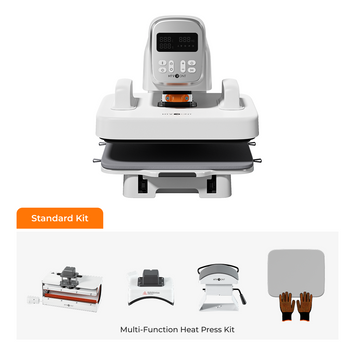
📱 Ready to start making phone cases? Here's everything you need:
Frequently Asked Questions
Can I use DTF transfers on a phone case with a regular heat press?
Yes—a standard flat heat press can apply DTF transfers to phone cases, but only for the flat back surface. You won't get the full‑wrap, edge‑to‑edge coverage that a vacuum phone case press provides. DTF on a flat press works best for front‑facing designs that don't need to wrap around edges.
What happens if I accidentally use sublimation ink in a DTF printer?
Sublimation ink is formulated completely differently from DTF ink. It can clog the printhead, produce no usable output, and potentially cause permanent damage. If this happens, stop immediately and run a thorough cleaning cycle with the correct cleaning solution. In severe cases, the printhead may need professional servicing or replacement.
Why can't I just skip the vacuum step and use the phone case press like a flat press?
You can technically use the phone case press without vacuum for simple flat transfers, but you're missing the machine's primary advantage—edge‑to‑edge wrapping. If you only need flat transfers, a standard flat heat press is more cost‑effective and versatile. The phone case press justifies its cost through the vacuum capability that produces full‑wrap results.
Is there any film that works for both DTF and sublimation?
No. DTF film and sublimation film vinyl are engineered for fundamentally different processes. DTF film is designed to hold ink and adhesive powder for a surface transfer. Sublimation film vinyl is designed to soften under heat and conform to 3D shapes while releasing dye as a gas. No single film does both reliably, and attempts to cross‑use them consistently fail.
Conclusion: Can a Phone Case Heat Press Machine Press DTF Prints?
A phone case heat press machine can apply heat, but it's designed around sublimation film vinyl softening under heat and then being vacuum‑wrapped around a phone case. DTF vinyl/film is not compatible with the vacuum step, and attempts to DTF‑print on sublimation film vinyl typically fail due to media feeding jams and film deformation during DTF powder curing. That's why we do not recommend using a phone case heat press machine for DTF heat pressing. The most dependable approach is to use the phone case press for what it's best at: vacuum sublimation on properly coated phone case blanks.


 Cart Unlocks Add-On Deals